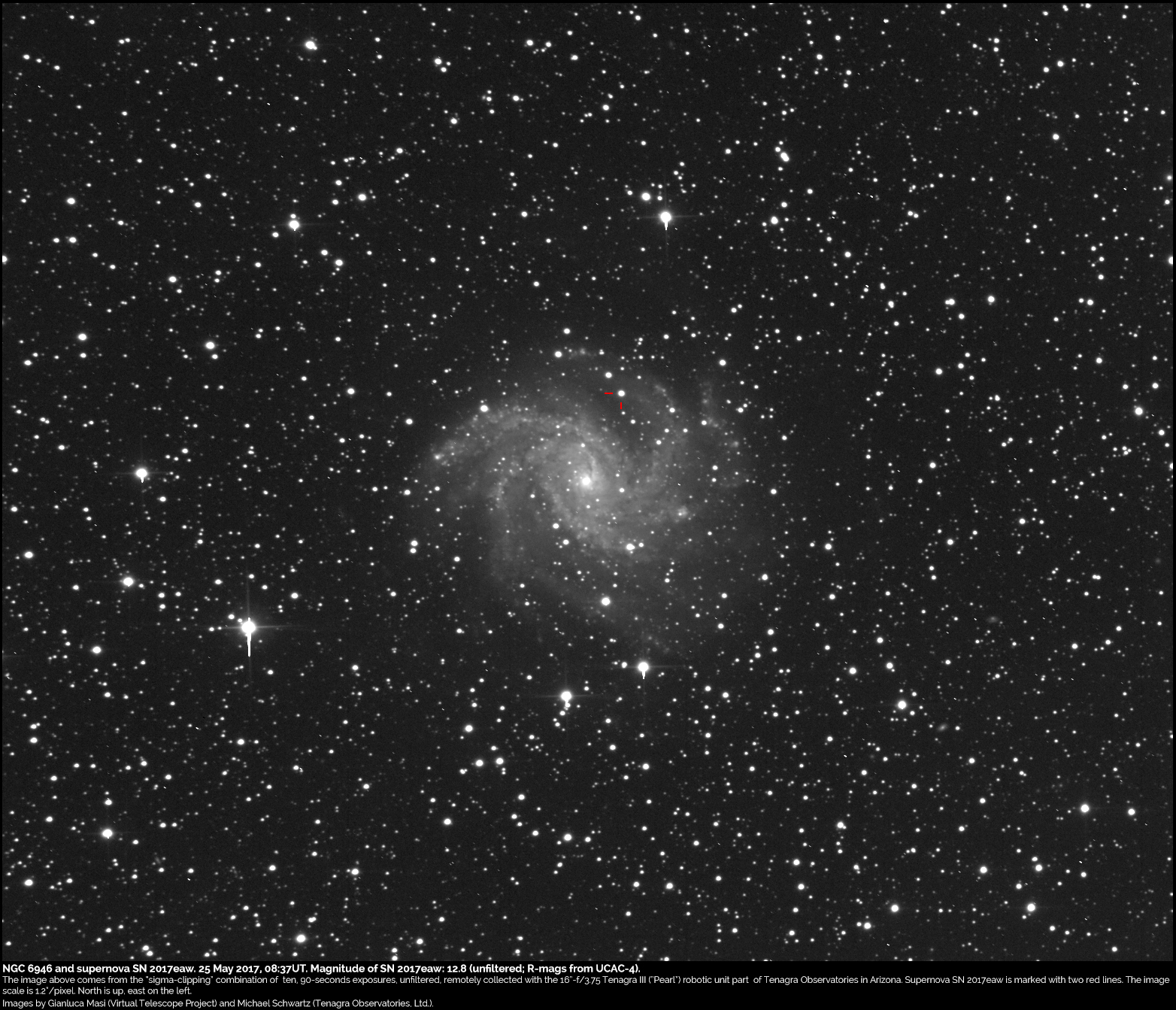
Supernova 2017eaw
Technologies:
Python
In the summer of 2023, I was awarded a fellowship overseas at the University of Cádiz (Escuela Ingenieria)
in Puerto Real, Andalucía, Spain. Here, I conducted research with my mentor, Dr. Antonia Morales Garoffolo,
alongside the CRISP collaboration of astrophysicists on the Polarimetry team. Here, I leveraged Python, combining
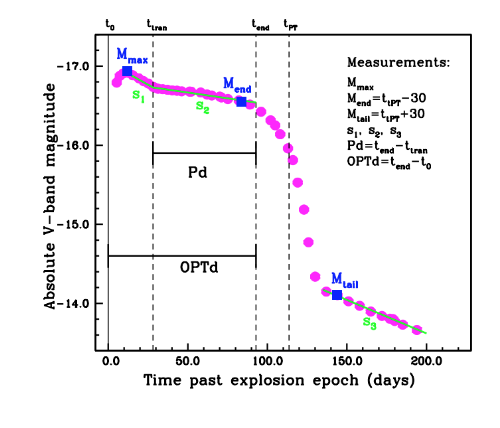
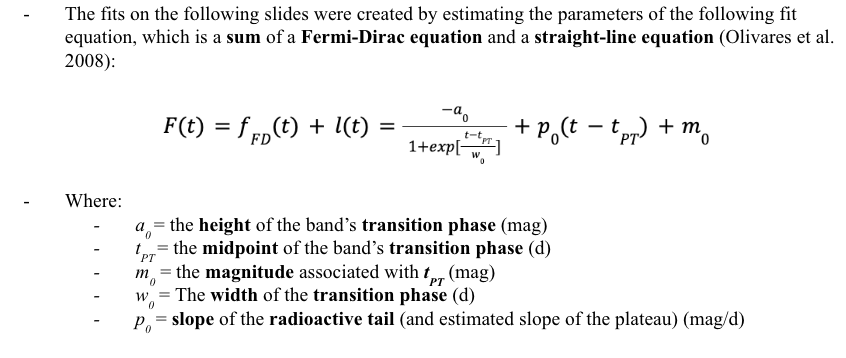
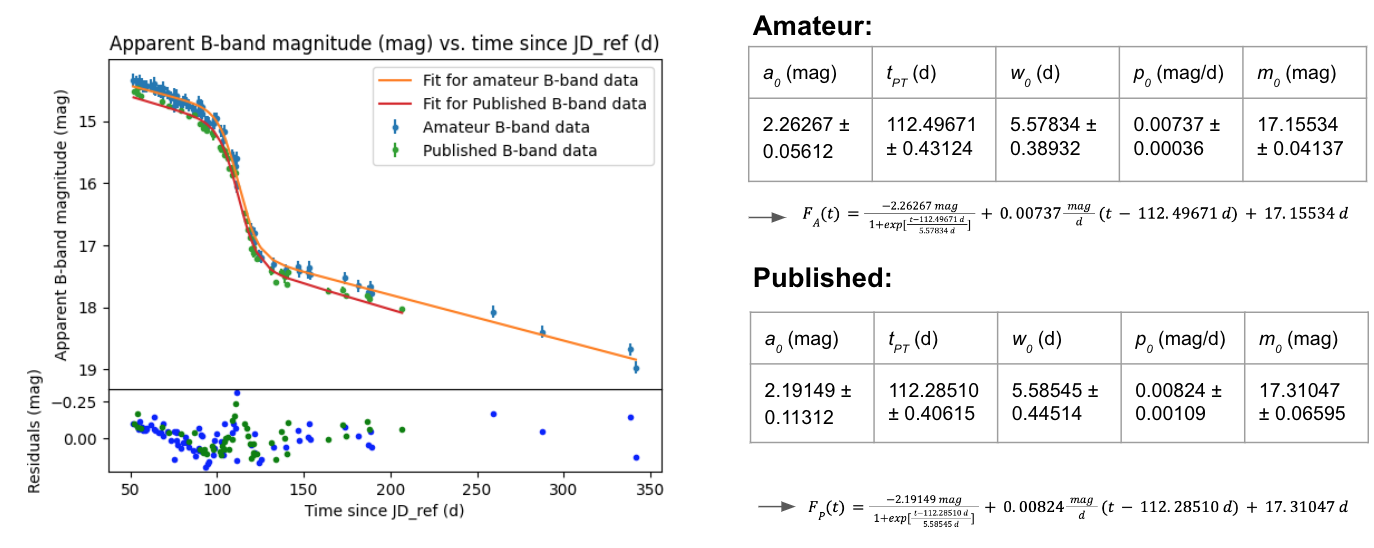
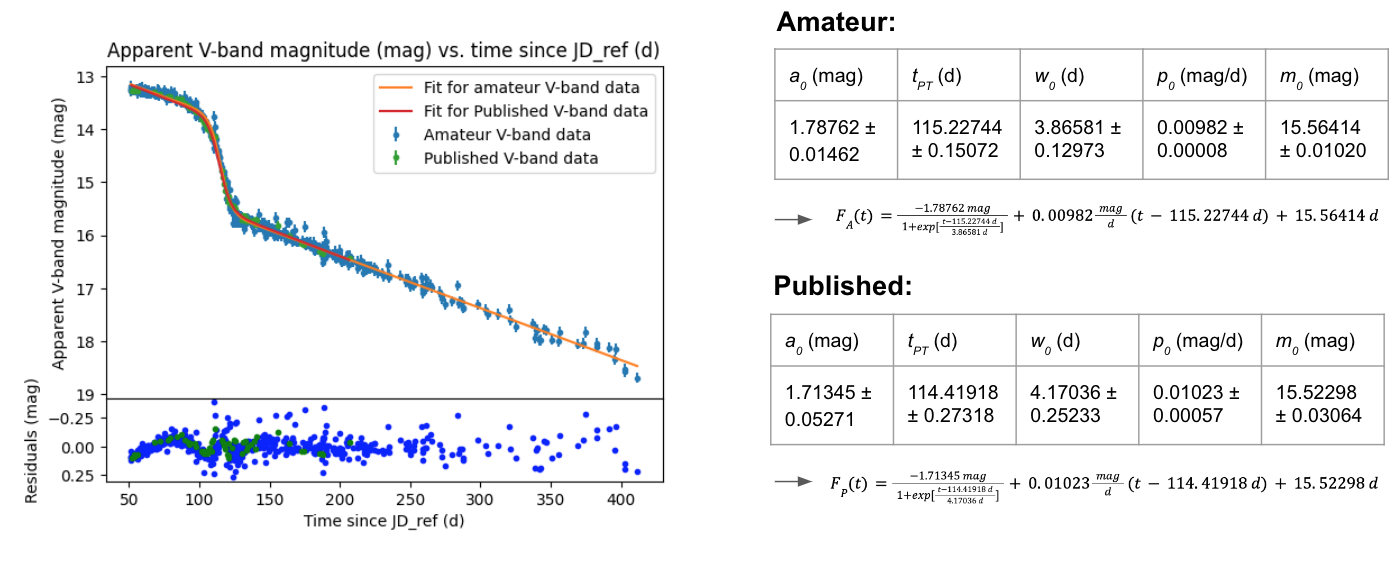
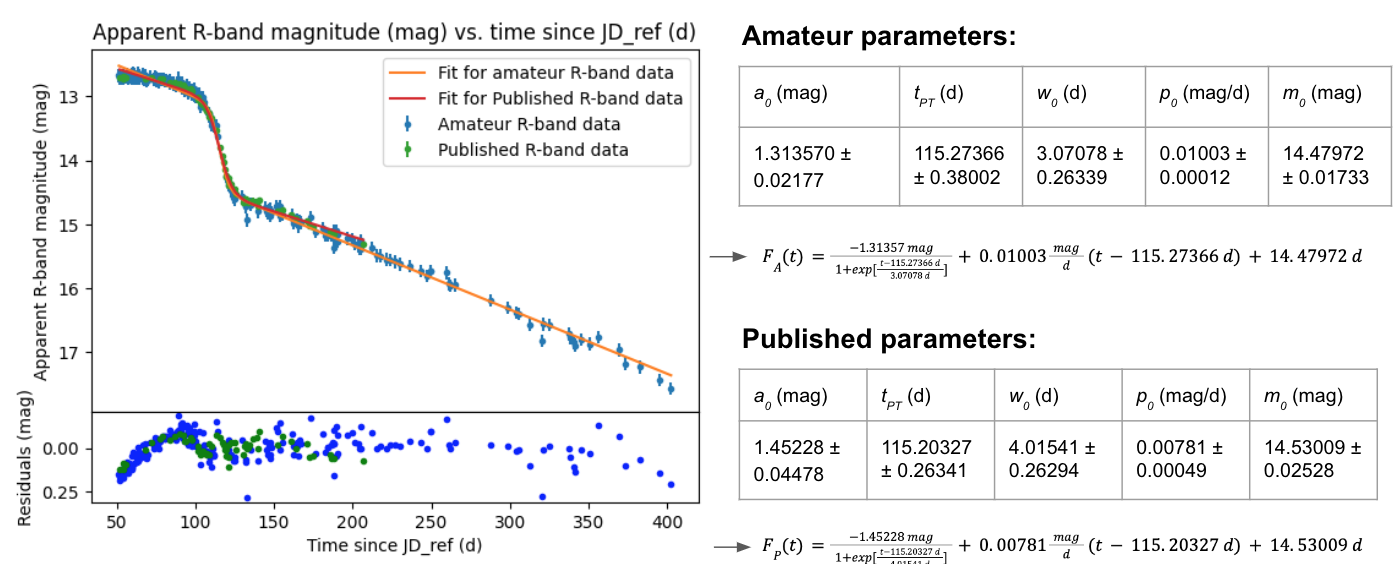
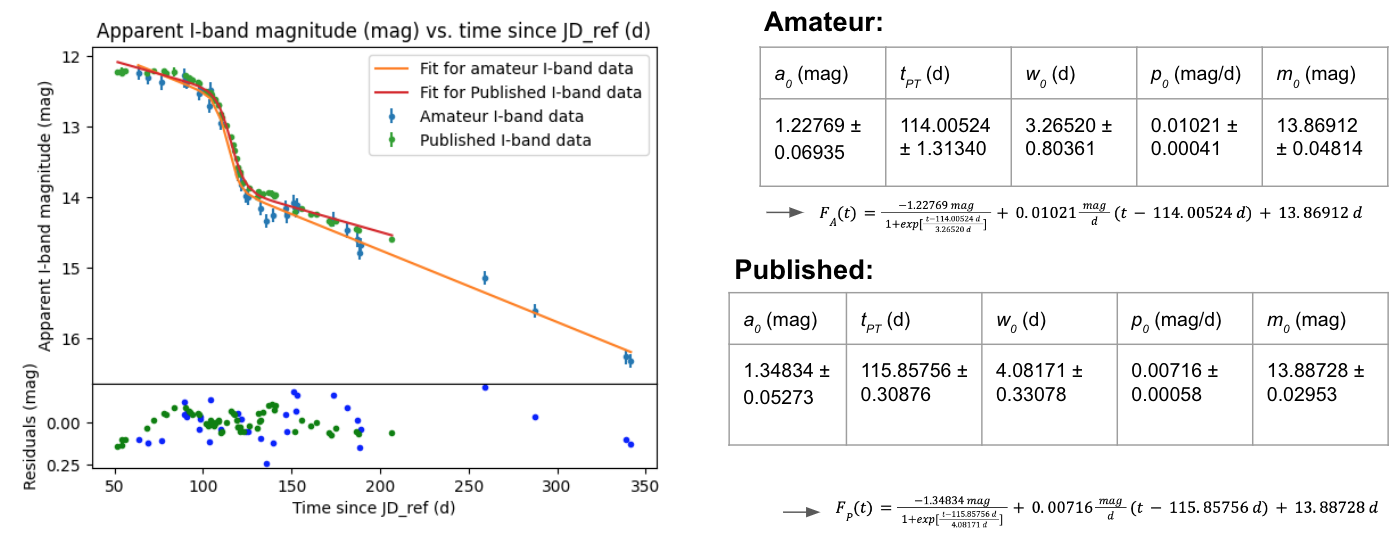
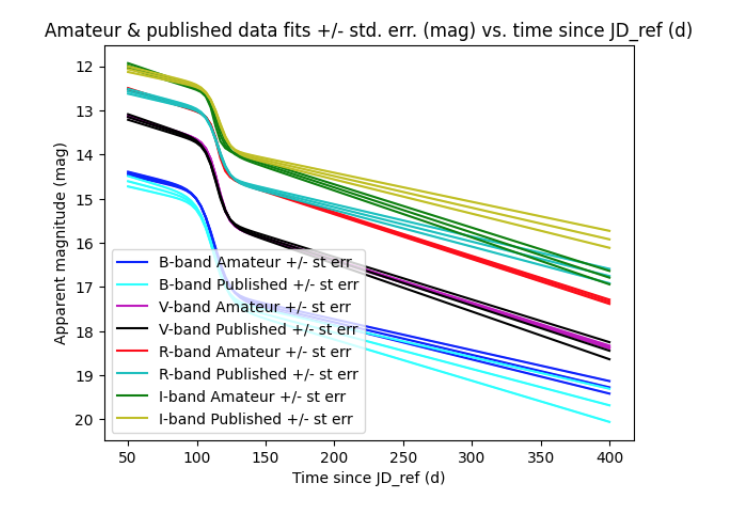
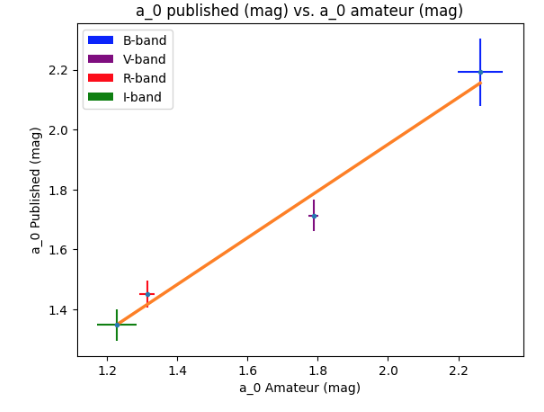
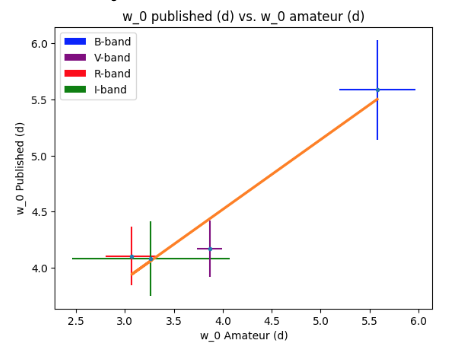
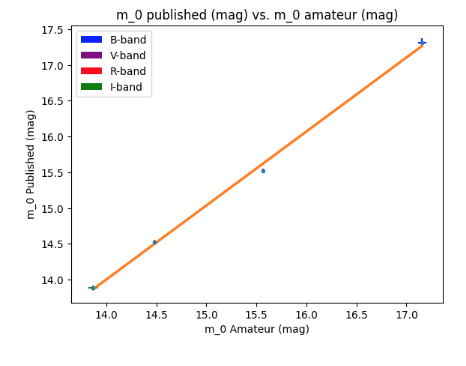
linear regression with Fermi-Dirac statistics to fit the blue-band, visible-band, red-band, and near-infrared-band light curves (light intensity over time) of supernova 2017eaw,
a core-collapse supernova in the galaxy NGC 6946. This unique combination of statistical methods gave way to fit functions
whose relative uncertainties were all roughly 10% or less. We used these fit functions to compare parameters derived from amateur and
published data of 2017eaw. We were able to establish a one-to-one relationship between three out of the five fit parameters,
signaling that the data was ready for further polarimetry studies.
I have presented this research at a conference, which you can learn more about on my Conferences page!
Gallery:
×
❮
![]() ❯
❯
References:
- Akrami, Yashar. “Supersymmetry vis-á-vis Observation”, PhD dissertation, Stockholm University, 2011.
- Anderson et al. (2014). “Characterizing the V-band Light-curves of Hydrogen-rich Type II Supernovae”, The Astrophysical Journal, 786(67), doi: 10.1088/0004-637X/786/1/67.
- Arcavi, Iair. “Hydrogen-Rich Core-Collapse Supernovae”, Springer International Publishing, 2017, 13.
- Gal-Yam, Avishay. "Observational and Physical Classification of Supernovae", Springer International Publishing, 2017, 12.
- Pian, Elena & Mazzali, Paolo A. “Hydrogen-Poor Core-Collapse Supernovae”, Springer International Publishing, 2017, 14.
- Olivares et al. (2008). “The Standardized Candle Method for Type II Plateau Supernovae”, The Astrophysical Journal, 715(2), doi: 10.1088/0004-637X/715/2/833.
- Reiss et al. (1998). “Observational Evidence from Supernovae for an Accelerating Universe and a Cosmological Constant”, The Astronomical Journal, 116(1009), doi: 10.1086/300499.
- “The Dispersion of Elements”, NASA, https://imagine.gsfc.nasa.gov/educators/lessons/xray_spectra/background-elements.html.
- Tomasella et al. (2013). “Comparison of progenitor mass estimates for the Type IIP SN 2012A”, Monthly Notices of the Royal Astronomical Society, 434(2), doi: 10.1093/mnras/stt1130.
- Tsvetkov et al. (2017). “The light curves of type II-P SN 2017eaw: first 200 days”, Cornell University, 1801(340), https://doi.org/10.48550/arXiv.1801.00340.
- “Webpage of the CRISP Project”, CRISP, https://sn-crisp.github.io/CRISP/.